
Population ageing and decline are becoming increasingly global phenomena. Across the world, populations are getting older and the proportion of young people is falling. In more and more places, population size is declining. First of the working-age population, and ultimately of the total population. This represents a fundamental shift from the pattern over the past half-century, when populations grew, labour supply increased and there was a global trend towards increasingly younger populations.
This global demographic transition also has major implications for countries like the Netherlands, but is still underappreciated both among the public and in policy circles. In this project, the WRR examines its implications for the structure of the Dutch economy, for our labour market and labour migration, for Dutch trade and for our pension provision. What policies are needed to respond to the risks and opportunities associated with demographic changes beyond our borders? What can the Dutch government do?
The project 'Netherlands in an Ageing and Shrinking World' is divided into two sub-reports: European ageing and pensions, and global population ageing and decline in relation to trade and labour migration. In both domains, the consequences of population ageing and decline abroad could be far-reaching. Therefore, the WRR considers it important that the Netherlands is prepared for this, at the national level and within the European context. The project formulates policy directions to respond to the possible impact of global demographic changes.
A Steady Global Demographic Transition
The world stands on the brink of a gradual but steady demographic transformation. Across the globe, life expectancy has increased in recent years and mortality rates and birth rates have declined. As a result, we see ageing and population decline occurring in more and more places – first of the working-age population and in many cases later of the total population. However, this transition is not proceeding at the same pace everywhere – some countries will shrink while others will continue to grow for the foreseeable future.
China, for instance, will age and shrink rapidly over the next 25 years – the potential working-age population will decline from approximately 1 billion currently, to a little over 700 million by the middle of the century. A country like Poland will experience a similar rapid population decline. Its working-age population will decline by more than a third over the next three decades.
Other countries, however, will remain relatively young for some time, with many people of working age. This can be seen in the figure, which shows the number of potential workers relative to the rest of the population. We see that whilst areas such as China and the Eastern EU countries had a relatively high labour supply over the past two decades, this will decline rapidly. This is shifting quickly towards India and in the longer term towards Africa.
Image: © UN / projections medium-variant
Trade, Labour and Migration
The places in the world where abundant labour potential exists are therefore changing. In this project, we study the consequences for the Netherlands of this shift in global labour potential. Our economy and society is heavily dependent on labour in and from other countries. Shops are full of products made elsewhere, and our own production also depends on intermediate products that come here through trade flows. Migrant workers provide all sorts of services here in the Netherlands and produce goods. For example, in construction, logistics, technology and agriculture – but increasingly also in a sector such as healthcare.
The demographic transition in countries with which the Netherlands has close economic ties through trade or labour migration will inevitably have consequences here too. Consider, for example, our economic dependence on labour migration. When important countries of origin such as Poland experience population decline and ageing, the inflow of personnel from those countries will decrease and is likely to eventually cease. This means that for labour migration in the future, we will become more dependent on inflows from countries outside the EU. Or our labour market may tighten further. Or consider trade patterns: in China, labour is rapidly becoming scarcer. This may shift China's position as the 'factory of the world' in favour of still relatively young countries such as India and Indonesia.
Responding to Demographic Changes Outside the Netherlands
Dutch trade and production must adapt to these developments, and our policy must respond. This can be done by establishing closer diplomatic and economic ties with countries with a (future) demographic dividend. Examples are stronger trade ties – such as through trade agreements -,, development partnerships, and migration partnerships. Dutch trade policy and labour migration policy can contribute to this, at national level and within the European Union.
In November 2025 the advisory report Aligning with global demographic shifts. Anticipating a shrinking labour supply abroad was published. In this report, the WRR argued for closer trader, development and migration ties to countries with a future demographic dividend. These can ben found primarily in south and southeast Asia (e.g. India, ASEAN-countries) and in Sub-Sahara Africa.
The report is currently only available in the original Dutch version. Two background studies, however, are already available in English. Harnessing and advancing Africa’s future demographic dividend analyses the potential for demographic dividend and future prosperity in Africa. The OECD working paper Assessing the impact of long-term global demographic changes on the Dutch economy and trade was funded by the WRR and analyses effects of global demographic change on the Dutch economy and trade. The English translation of the full report is expected in 2026.
European Ageing
Ageing also has implications for the Netherlands' position within the European Union. The Netherlands is in an exceptional position. Within Europe, we are relatively less 'grey' and our pension provision is much more based on pension savings accumulated over decades. In an ageing Europe, such differences can lead to tensions between EU countries. The question is how these change the Netherlands' position within the European political balance of power.
The WRR studied this in the report European Ageing in Focus: Dealing with Pension and Budgetary Risks. This report was presented to the Minister of Finance on behalf of the Cabinet on 25 September 2024. An English translation of the report is expected to be published mid 2026 in the Research for Policy series. Studies by the Netherlands Council for Government Policy by Springer publishers.
News
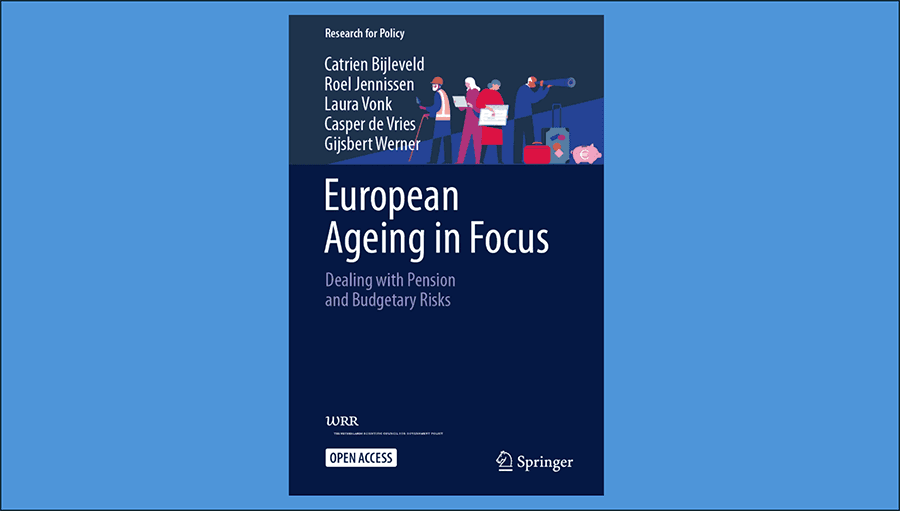
Springer publishes WRR report on European ageing
The tittle European Ageing in Focus. Dealing with Pension and budgetary risks has just been published by Springer Publishers. It ...
Read more
Harnessing and advancing Africa’s future demographic dividend
Africa’s demographic future will play a defining role in shaping the continent’s development trajectory and position in the ...
Read more
Demographic developments abroad have an impact on the Dutch economy and trade
Major demographic changes abroad can affect trade flows to and from the Netherlands. This is shown by two Working Papers ...
Read more