
In today’s society, people are expected to take responsibility for their own lives and be self-reliant. This is no easy feat. They must be on constant high alert in areas of life such as health, work and personal finances and, if things threaten to go awry, take appropriate action without further ado. Today's society needs a more realistic perspective on self-reliance, with rules and institutions that allow for the natural limitations in people’s ‘capacity to act’.
Image: © wrr
Characteristics and mental capacities
There is a difference between what people are expected to do and what they are actually capable of. It is not just a small group of ‘vulnerable’ individuals, for example those with a low IQ, who have trouble living up to such expectations. Also people with a good education and a favourable position in society can end up feeling overwhelmed, certainly when they are going through a difficult patch. That is not because they are not intelligent or knowledgeable enough, but because demands are being made on all sorts of other mental capacities, such as the capacity to take action, to remain calm, and to stick to their resolutions.
Video Why knowing what to do is not enough - extended version

Title: Why knowing what to do is not enough.
Anne-Greet Keizer – Research fellow WRR:
In today’s society people are expected
to take responsibility and be self-reliant.They must be on constant high alert in areas
such as health, work and personal finances.But there’s a difference between what governments
expect of people and what they can actually handle.And this is not confined to just
a small vulnerable group.Even highly educated people sometimes drop the ball
by not paying attention or postponing things.And sometimes government itself
makes people less self-reliant.For instance: in a system of cumulative fines.
Ignoring a small traffic fine can
quickly amount to problematic debts.This book explains why knowing
what to do is not enough.It focuses on people’s capacity to act:
non-cognitive capacities such assetting goals, taking action, persevering
and coping with temptations and setbacks.People differ in the degree to which
they possess these capacities.That’s been shown in the Marshmallow Test.
Small children are offered a choice:You can eat the marshmallow,
but if you wait, you’ll get two.We see how children
handle the temptation differently.Children who were able to wait longer
did better at school later on.It makes sense for governments
to take this notion into account.Governments should gauge the mental capacities of people realistically.
That’s good for people’s self-reliance
and the exchequer and for the legitimacy
of government.Title: determinants of the capacity to act.
Certain traits are particularly
important to self-reliance.Temperament, self-control and belief.
Title:Temperament.
People with an approach temperament
recognise difficult situations...and take action.
People with an avoidance temperament
avoid difficult situations and go into denial.Title: Self-control.
Self-control is the ability to change
or suppress dominant behavioural tendenciesand regulate behaviour,
thoughts and emotions.Title: Belief.
One person may be an optimist and think
‘It will turn out alright’.Another may be a pessimist and slide
into helplessness and passivity.These differences are to some extent related to
level of education, but not entirely.They generally follow a normal distribution.
Some people score low, others good...but most(pause)about
average.Stress and mental burden
also put pressure on capacity to act.The problem is worse when life is tough...
for example, during bankruptcy, divorce or dismissal.These situations cause
particular stress.Research shows we should not have high expectations
when it comes to training capacity to act.There are no simple,
quick, cheap solutions.Differences will always exist.
We call for a realistic perspective...
in the preparation,
content and implementation of policy.Title: Stress and mental burden.
New policies should be tested
to measure the total mental burdenand examine whether they are
doable for the public.Governments can reduce mental strain,
Especially during life eventsby not just providing information
but also changing choice architecture.By ticking default options, for example,
or reducing temptations...so that people don’t constantly have to
rely on their self-control.From a realistic perspective
Serious offences merit serious sanctions,but small mistakes
should only have minor consequences.Any irregularities should result in
early, personal contact.Because when people are not too stressed yet,
they still have some mental space...to make changes.
For more information go to our website
or download an open access copy at springer.com.
Self-reliance and public policy
What does this mean for public policy? Policymakers tend to assume that the government only needs to provide people with clear information and that, once properly informed, they will automatically do the right thing. However, it is becoming increasingly obvious that things do not work like that. Even though people know perfectly well what they ought to do, they often behave differently.
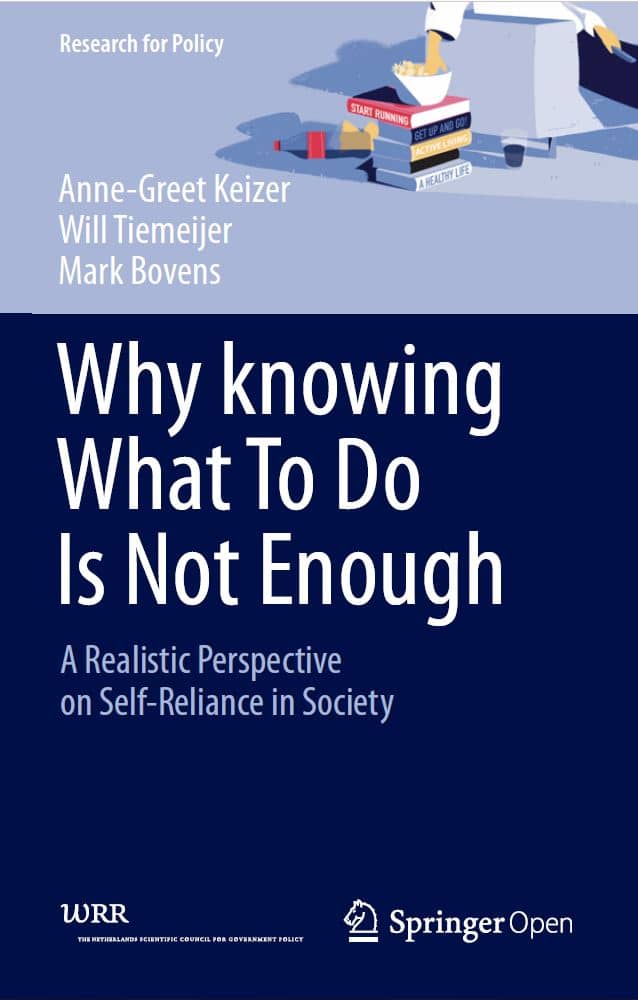
Why is this? This research sets out to explain the reasons for the gap between ‘knowing’ and ‘doing’. It focuses on the role of non-cognitive capacities, such as setting goals, taking action, persevering and coping with setbacks, and shows how these capacities are undermined by adverse circumstances. By taking the latest psychological insights fully into account, a more realistic perspective on self-reliance, and shows government officials how to design rules and institutions that allow for the natural limitations in people’s ‘capacity to act’.
The report is the product of an extensive process of consultation and analysis. In addition to studying the academic literature, the authors, Anne-Greet Keizer, Will Tiemeijer and Mark Bovens, conducted more than 90 interviews with experts, policy makers and stakeholders.
International context
‘Why knowing what to do is not enough’ is a translation and adaption of the Dutch report ‘Weten is nog geen doen’, published by the Netherlands Scientific Council for Government Policy (WRR) and presented to the State Secretary of Security and Justice in 2017. In this study, the WRR advises the Dutch government to take a realistic approach on people’s mental capacities when designing rules and institutions. The government gave its formal response in a Memorandum to Parliament, in which it did indeed commit to embracing a more realistic approach and announced that new policies will be subjected to a ‘capacity to act test’.
‘Why knowing what to do is not enough – a realistic perspective on self-reliance’ is published by Springer, an international scientific publishing house. You can order a hardcopy for a set price or download the ebook version freely available through open access via the Springerwebsite